
- About us
- Contact us: +1.641.472.4480, hfi@humanfactors.com
Cool stuff and UX resources


Introduction
The eye tracking lab has always been the Disney equivalent for real usability wonks. It's so cool. For years we said, there MUST be something about the data that it collects that can take usability to the next level. For years the pragmatists (including HFI's own) have pushed back. It's too complex to use. It takes too long to calibrate. The data is overwhelming to assimilate and interpret. Valid eye tracking tests require a different philosophical approach to the usability testing interaction. Eye trackers are not cheap.
Some of these criticisms still ring true. Eye trackers are still not cheap. New software algorithms make first-pass analysis of the data easy, but to effectively interpret and leverage the data it entails an understanding of perception, reading and (yawn) statistical analysis. The way usability tests are choreographed needs to change if you are going to collect valid eye tracking data. (For instance, setting up a scenario where the participant tends to look at the tester each time there is a probe undermines the validity of the scan path.)
However, the days of drooling on a bite bar through 30 minutes of calibration are over. And the physical evolution of eye trackers is opening unique opportunities to refine and hone your information architecture.
Eye tracking data isn't only skin deep
People tilt their heads when you say that eyetracking should be used to refine the information architecture. The typical response is, "You mean graphics, right? What catches the attention? How long do people linger? What do they LOOK at?"
Right. That's all true. Eye tracking data is effective – particularly when used in conjunction with click stream analytics – for assessing the attentional draw of marketing elements on a page.
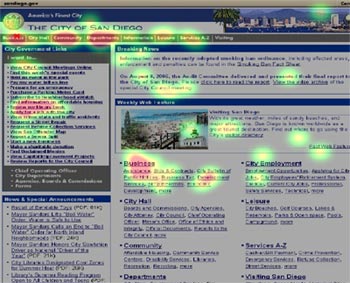
But this same type of data is also very useful in evaluating and understanding the effectiveness of the information architecture. Consider the eye tracking heat map below. This heat map reflects the visual search of a single user seeking San Diego traffic information on the City of San Diego home page.
The red spots (or "hotspots") show where the user looked longest. In this picture, longest is a combination of either lingering on an area (as in the Business section in the main text) or where they repeatedly looked before making a decision (as in the navigation tabs). (Additional first and second "pass" looking data can be used to tease these two behaviors apart.)
So in their simplest form, eye tracking heat maps, like the one shown above, can be used to evaluate:
- Do users know where to start? Analyzed by evaluating how many warm spots there are on the page. (Lots is not good!) And critically, if the true target is "cold," or never gazed at.
- Are they confident when they find it? Evaluated by looking at how many times users look back and forth between options before they select one and click.
Bojko (2006) presents a study which demonstrates the value of including eye-tracking methods in early prototype testing. Her team used eye tracking methods to compare the content findability of key and frequent elements on a proposed homepage redesign of a medical professional society site against the existing site. The redesign objective was to highlight key functionality and improve the findability of critical information. The team used conventional usability methods (interviews, card sorting, etc.) to inform the redesign.
Had she evaluated only conventional usability measures (accuracy and time-on-task), the two designs would have performed roughly equally. However, in-depth analysis showed some interesting differences between the two designs at the task level.
For instance, while one core task was completed in just a few second on either design, behavioral analysis showed that the proposed redesign was much more efficient: Fixations (spots where the eye lands) were numerous and scattered on the old site, but they tended to be focused around a single, more clearly presented navigation design for the prototype site. This is not surprising, since the new design effectively reduced the number of competing and distracting elements on the homepage. Not surprising, sure. But hindsight is 20/20. Eye tracking provided clear validation for the explanation: Users' eyes wandered around less on the new design. Usability practitioners need empirical validation to move the field forward. Traditional usability testing data simply can't provide this level of interpretive insight.
A further analysis of the eye tracking data showed that the revised navigation labels also improved the site usability. Users were more confident about the meaning of labels: They looked for shorter times, they looked back and forth less, and they selected and clicked links more quickly.
Bojko uses these examples to suggest that eye tracking offers both quantitative evidence to validate redesign choices, and qualitative process insights to further refine designs. Some of the quantitative data she uses comes from conventional usability measures such as success rates and time on task. But other data, such as visual linger times and scan paths, depend on applying eye tracking methods. Qualitative data provides insight, by observing where users are looking, to identify efficiencies and inefficiencies in the task flow.
The eyes have it
Recent improvements in eye tracking technology suggest that it may be time to start taking eye tracking seriously as a standard usability method.
References
Bojko, A. (2006). Using Eye Tracking to Compare Web Page Designs: A Case Study, Journal of Usability Studies, Issue 3, Vol. 1, pp. 112-120.
Message from the CEO, Dr. Eric Schaffer — The Pragmatic Ergonomist

Yawn.
I'm only interested in this cool eye tracking data if it first of all tells us something that makes us change the design. And second, if it tells us something we could not know cheaper and easier.
"Validation" is nice. But most of the time with eye tracking I seem to be seeing insights so obvious that I could just ask my Mom and she would know.
Kath made me buy one. Maybe it WILL be useful for super critical applications. Or maybe it will just keep my esteemed Chief Scientist entertained.
Leave a comment here
Reader comments
Howard Tamler
AMDOCS
I agree completely with Dr. Schaffer. I think its major value is for marketing, rather than usability assessment. Given the kind of cost-benefit considerations that govern the business world, I don't see how I could justify the time, effort, and expense.
Michael K. B. Warner
Joint Transformation Command - US Military
Excellent article. Visual eye movement map example very useful. Passing article to our webmasters as reference for future Home Page design implementation. Thank you for useful information.
Jack Bellis
UsabilityInsititute.com
Thank you Eric for just plain common sense.
Shuan
It will be great if you can post some information on how to analyze data from eye-tracking studies. For instance, how do we know if a spot is hot because the information in that spot is perceived as important or because the user requires a longer time to understand the presented information? I suppose that such an article would be nice.
Subscribe
Sign up to get our Newsletter delivered straight to your inbox
Privacy policy
Reviewed: 18 Mar 2014
This Privacy Policy governs the manner in which Human Factors International, Inc., an Iowa corporation (“HFI”) collects, uses, maintains and discloses information collected from users (each, a “User”) of its humanfactors.com website and any derivative or affiliated websites on which this Privacy Policy is posted (collectively, the “Website”). HFI reserves the right, at its discretion, to change, modify, add or remove portions of this Privacy Policy at any time by posting such changes to this page. You understand that you have the affirmative obligation to check this Privacy Policy periodically for changes, and you hereby agree to periodically review this Privacy Policy for such changes. The continued use of the Website following the posting of changes to this Privacy Policy constitutes an acceptance of those changes.
Cookies
HFI may use “cookies” or “web beacons” to track how Users use the Website. A cookie is a piece of software that a web server can store on Users’ PCs and use to identify Users should they visit the Website again. Users may adjust their web browser software if they do not wish to accept cookies. To withdraw your consent after accepting a cookie, delete the cookie from your computer.
Privacy
HFI believes that every User should know how it utilizes the information collected from Users. The Website is not directed at children under 13 years of age, and HFI does not knowingly collect personally identifiable information from children under 13 years of age online. Please note that the Website may contain links to other websites. These linked sites may not be operated or controlled by HFI. HFI is not responsible for the privacy practices of these or any other websites, and you access these websites entirely at your own risk. HFI recommends that you review the privacy practices of any other websites that you choose to visit.
HFI is based, and this website is hosted, in the United States of America. If User is from the European Union or other regions of the world with laws governing data collection and use that may differ from U.S. law and User is registering an account on the Website, visiting the Website, purchasing products or services from HFI or the Website, or otherwise using the Website, please note that any personally identifiable information that User provides to HFI will be transferred to the United States. Any such personally identifiable information provided will be processed and stored in the United States by HFI or a service provider acting on its behalf. By providing your personally identifiable information, User hereby specifically and expressly consents to such transfer and processing and the uses and disclosures set forth herein.
In the course of its business, HFI may perform expert reviews, usability testing, and other consulting work where personal privacy is a concern. HFI believes in the importance of protecting personal information, and may use measures to provide this protection, including, but not limited to, using consent forms for participants or “dummy” test data.
The Information HFI Collects
Users browsing the Website without registering an account or affirmatively providing personally identifiable information to HFI do so anonymously. Otherwise, HFI may collect personally identifiable information from Users in a variety of ways. Personally identifiable information may include, without limitation, (i)contact data (such as a User’s name, mailing and e-mail addresses, and phone number); (ii)demographic data (such as a User’s zip code, age and income); (iii) financial information collected to process purchases made from HFI via the Website or otherwise (such as credit card, debit card or other payment information); (iv) other information requested during the account registration process; and (v) other information requested by our service vendors in order to provide their services. If a User communicates with HFI by e-mail or otherwise, posts messages to any forums, completes online forms, surveys or entries or otherwise interacts with or uses the features on the Website, any information provided in such communications may be collected by HFI. HFI may also collect information about how Users use the Website, for example, by tracking the number of unique views received by the pages of the Website, or the domains and IP addresses from which Users originate. While not all of the information that HFI collects from Users is personally identifiable, it may be associated with personally identifiable information that Users provide HFI through the Website or otherwise. HFI may provide ways that the User can opt out of receiving certain information from HFI. If the User opts out of certain services, User information may still be collected for those services to which the User elects to subscribe. For those elected services, this Privacy Policy will apply.
How HFI Uses Information
HFI may use personally identifiable information collected through the Website for the specific purposes for which the information was collected, to process purchases and sales of products or services offered via the Website if any, to contact Users regarding products and services offered by HFI, its parent, subsidiary and other related companies in order to otherwise to enhance Users’ experience with HFI. HFI may also use information collected through the Website for research regarding the effectiveness of the Website and the business planning, marketing, advertising and sales efforts of HFI. HFI does not sell any User information under any circumstances.
Disclosure of Information
HFI may disclose personally identifiable information collected from Users to its parent, subsidiary and other related companies to use the information for the purposes outlined above, as necessary to provide the services offered by HFI and to provide the Website itself, and for the specific purposes for which the information was collected. HFI may disclose personally identifiable information at the request of law enforcement or governmental agencies or in response to subpoenas, court orders or other legal process, to establish, protect or exercise HFI’s legal or other rights or to defend against a legal claim or as otherwise required or allowed by law. HFI may disclose personally identifiable information in order to protect the rights, property or safety of a User or any other person. HFI may disclose personally identifiable information to investigate or prevent a violation by User of any contractual or other relationship with HFI or the perpetration of any illegal or harmful activity. HFI may also disclose aggregate, anonymous data based on information collected from Users to investors and potential partners. Finally, HFI may disclose or transfer personally identifiable information collected from Users in connection with or in contemplation of a sale of its assets or business or a merger, consolidation or other reorganization of its business.
Personal Information as Provided by User
If a User includes such User’s personally identifiable information as part of the User posting to the Website, such information may be made available to any parties using the Website. HFI does not edit or otherwise remove such information from User information before it is posted on the Website. If a User does not wish to have such User’s personally identifiable information made available in this manner, such User must remove any such information before posting. HFI is not liable for any damages caused or incurred due to personally identifiable information made available in the foregoing manners. For example, a User posts on an HFI-administered forum would be considered Personal Information as provided by User and subject to the terms of this section.
Security of Information
Information about Users that is maintained on HFI’s systems or those of its service providers is protected using industry standard security measures. However, no security measures are perfect or impenetrable, and HFI cannot guarantee that the information submitted to, maintained on or transmitted from its systems will be completely secure. HFI is not responsible for the circumvention of any privacy settings or security measures relating to the Website by any Users or third parties.
Correcting, Updating, Accessing or Removing Personal Information
If a User’s personally identifiable information changes, or if a User no longer desires to receive non-account specific information from HFI, HFI will endeavor to provide a way to correct, update and/or remove that User’s previously-provided personal data. This can be done by emailing a request to HFI at hfi@humanfactors.com. Additionally, you may request access to the personally identifiable information as collected by HFI by sending a request to HFI as set forth above. Please note that in certain circumstances, HFI may not be able to completely remove a User’s information from its systems. For example, HFI may retain a User’s personal information for legitimate business purposes, if it may be necessary to prevent fraud or future abuse, for account recovery purposes, if required by law or as retained in HFI’s data backup systems or cached or archived pages. All retained personally identifiable information will continue to be subject to the terms of the Privacy Policy to which the User has previously agreed.
Contacting HFI
If you have any questions or comments about this Privacy Policy, you may contact HFI via any of the following methods:
Human Factors International, Inc.
PO Box 2020
1680 highway 1, STE 3600
Fairfield IA 52556
hfi@humanfactors.com
(800) 242-4480
Terms and Conditions for Public Training Courses
Reviewed: 18 Mar 2014
Cancellation of Course by HFI
HFI reserves the right to cancel any course up to 14 (fourteen) days prior to the first day of the course. Registrants will be promptly notified and will receive a full refund or be transferred to the equivalent class of their choice within a 12-month period. HFI is not responsible for travel expenses or any costs that may be incurred as a result of cancellations.
Cancellation of Course by Participants (All regions except India)
$100 processing fee if cancelling within two weeks of course start date.
Cancellation / Transfer by Participants (India)
4 Pack + Exam registration: Rs. 10,000 per participant processing fee (to be paid by the participant) if cancelling or transferring the course (4 Pack-CUA/CXA) registration before three weeks from the course start date. No refund or carry forward of the course fees if cancelling or transferring the course registration within three weeks before the course start date.
Cancellation / Transfer by Participants (Online Courses)
$100 processing fee if cancelling within two weeks of course start date. No cancellations or refunds less than two weeks prior to the first course start date.
Individual Modules: Rs. 3,000 per participant ‘per module’ processing fee (to be paid by the participant) if cancelling or transferring the course (any Individual HFI course) registration before three weeks from the course start date. No refund or carry forward of the course fees if cancelling or transferring the course registration within three weeks before the course start date.
Exam: Rs. 3,000 per participant processing fee (to be paid by the participant) if cancelling or transferring the pre agreed CUA/CXA exam date before three weeks from the examination date. No refund or carry forward of the exam fees if requesting/cancelling or transferring the CUA/CXA exam within three weeks before the examination date.
No Recording Permitted
There will be no audio or video recording allowed in class. Students who have any disability that might affect their performance in this class are encouraged to speak with the instructor at the beginning of the class.
Course Materials Copyright
The course and training materials and all other handouts provided by HFI during the course are published, copyrighted works proprietary and owned exclusively by HFI. The course participant does not acquire title nor ownership rights in any of these materials. Further the course participant agrees not to reproduce, modify, and/or convert to electronic format (i.e., softcopy) any of the materials received from or provided by HFI. The materials provided in the class are for the sole use of the class participant. HFI does not provide the materials in electronic format to the participants in public or onsite courses.