
- About us
- Contact us: +1.641.472.4480, hfi@humanfactors.com
Cool stuff and UX resources


The sneezing, sniffling, achy, head fever so you can rest easier with your decision
The Web has absolutely improved the world for shopping. With a few minutes effort, you can get almost anything... from almost anywhere. The opportunities are endless.
On the flip side, e-commerce companies can now attract customers from almost anywhere at any time. With a solid, usable site, the world is their customer base, right? Maybe. Organizations struggle with globalization-localization issues. Can one site fit all? Can parts of the design be standardized? Which parts need to be localized?
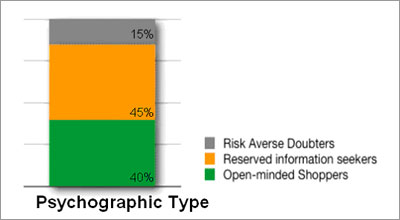
Barnes and colleagues (2006) report the findings that provide the beginning of an answer. They conducted a psychographic survey and cluster analysis of Internet users that segments Internet shoppers into three groups:
Risk-averse doubters – About 15 % of the overall population, risk-averse doubters are careful and suspicious. They don't particularly like new experiences and tend not to use the Internet to shop – either for information or purchase.
Open-minded shoppers – This group likes new and exciting experiences. They don't consider the Web to be a particularly risky place to shop and generally trust their online vendors. They like to shop and they like the fact that the Internet widens their choices dramatically. About 40% of the survey respondents overall fit into this type.
Reserved information seekers – The rest of the respondents (about 45%) are open to online shopping but tend to use the Web more for research and pre-purchase evaluations. They use the Web, but they go to the store to buy.
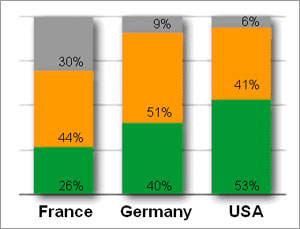
These segments that emerged aren't all that surprising. We've known for (Internet) ages that there are basically early adopters, cautious lurkers and nay-sayers. The interesting part of the study is how these groups distribute within the three countries that they studied: Germany, France, and the US.
Most of the open-minded shoppers (45%) were from the US. In contrast, most of the risk-averse doubters are French (66%). Germans are very open to online shopping, but tend toward using the Web for research and comparison. The relative distribution of the three types of Internet shoppers within each country is shown below.
Little facts like this always make great conversation starters. But they also provide critical input for designers creating multi-national e-commerce sites. The design elements that elicit trust for the typical open-minded American Internet shopper will not be the right ones to engage and persuade a French consumer. One site does not fit all.
References
Barnes, S.J., Bauer, H.H., Neumann, M.M., and Huber, F. (2007). Segmenting cyberspace: a customer typology for the internet. European Journal of Marketing Vol. 41 No. 1/2, pp. 71-93.
Leave a comment here
Reader comments
Venkat C. Nallanthighal
This article is mainly based on the quoted survey results. The article mentions that Americans (53%) tend to be more "open minded" compared to the other countries mentioned in the survey. In the follow-up, Dr. Schaffer wrote "In India, there is a worry about fraud: 'Will the product be delivered?' In China, the question is more about whether the product will be real or fake." That conclusion looks like a "stereotyping" to me. I am sorry I didn't see any supporting data for that observation.
If I am (an Indian American) ordering in US, I have more confidence when I buy products from known websites and delivery networks (like amazon.com). At the same time, I would be very cautious about products that come from outside US and unknown websites.
If I am ordering from amazon.com in India, I will have the same confidence because of the Amazon (very well-known website) and US business practices (the confidence factor). My cultural identity doesn't really impact when I shop online. That's why I have to post this comment.
Elianna James
OCLC
These findings are of vital importance to any company which is attempting a "global" strategy. Woe to those who think that everyone "thinks" the same. Would like to see more research, especially comparing younger, web-connected people from various geographic areas. Is globalization making an impact when age/ web experience is factored in?
Sandra Niehaus
Very intriguing article! any way to get the full text?
Response from Kath Straub:
The reference is included in the bibliography. You should be able to purchase the article on the Net ($35.50 USD) from IngentaConnect, or perhaps you can access it at your local (academic) library.
Ron Harding, Datatel, Inc.
Statistics can be very misleading. Do the statistics indicate a difference in the people in a given country, or is it an indication of the level of service? Do you cater to the U.S. because the population is more ready to shop, or do you cater to France because you have less competition and the population is looking for somewhere to shop?
Subscribe
Sign up to get our Newsletter delivered straight to your inbox
Privacy policy
Reviewed: 18 Mar 2014
This Privacy Policy governs the manner in which Human Factors International, Inc., an Iowa corporation (“HFI”) collects, uses, maintains and discloses information collected from users (each, a “User”) of its humanfactors.com website and any derivative or affiliated websites on which this Privacy Policy is posted (collectively, the “Website”). HFI reserves the right, at its discretion, to change, modify, add or remove portions of this Privacy Policy at any time by posting such changes to this page. You understand that you have the affirmative obligation to check this Privacy Policy periodically for changes, and you hereby agree to periodically review this Privacy Policy for such changes. The continued use of the Website following the posting of changes to this Privacy Policy constitutes an acceptance of those changes.
Cookies
HFI may use “cookies” or “web beacons” to track how Users use the Website. A cookie is a piece of software that a web server can store on Users’ PCs and use to identify Users should they visit the Website again. Users may adjust their web browser software if they do not wish to accept cookies. To withdraw your consent after accepting a cookie, delete the cookie from your computer.
Privacy
HFI believes that every User should know how it utilizes the information collected from Users. The Website is not directed at children under 13 years of age, and HFI does not knowingly collect personally identifiable information from children under 13 years of age online. Please note that the Website may contain links to other websites. These linked sites may not be operated or controlled by HFI. HFI is not responsible for the privacy practices of these or any other websites, and you access these websites entirely at your own risk. HFI recommends that you review the privacy practices of any other websites that you choose to visit.
HFI is based, and this website is hosted, in the United States of America. If User is from the European Union or other regions of the world with laws governing data collection and use that may differ from U.S. law and User is registering an account on the Website, visiting the Website, purchasing products or services from HFI or the Website, or otherwise using the Website, please note that any personally identifiable information that User provides to HFI will be transferred to the United States. Any such personally identifiable information provided will be processed and stored in the United States by HFI or a service provider acting on its behalf. By providing your personally identifiable information, User hereby specifically and expressly consents to such transfer and processing and the uses and disclosures set forth herein.
In the course of its business, HFI may perform expert reviews, usability testing, and other consulting work where personal privacy is a concern. HFI believes in the importance of protecting personal information, and may use measures to provide this protection, including, but not limited to, using consent forms for participants or “dummy” test data.
The Information HFI Collects
Users browsing the Website without registering an account or affirmatively providing personally identifiable information to HFI do so anonymously. Otherwise, HFI may collect personally identifiable information from Users in a variety of ways. Personally identifiable information may include, without limitation, (i)contact data (such as a User’s name, mailing and e-mail addresses, and phone number); (ii)demographic data (such as a User’s zip code, age and income); (iii) financial information collected to process purchases made from HFI via the Website or otherwise (such as credit card, debit card or other payment information); (iv) other information requested during the account registration process; and (v) other information requested by our service vendors in order to provide their services. If a User communicates with HFI by e-mail or otherwise, posts messages to any forums, completes online forms, surveys or entries or otherwise interacts with or uses the features on the Website, any information provided in such communications may be collected by HFI. HFI may also collect information about how Users use the Website, for example, by tracking the number of unique views received by the pages of the Website, or the domains and IP addresses from which Users originate. While not all of the information that HFI collects from Users is personally identifiable, it may be associated with personally identifiable information that Users provide HFI through the Website or otherwise. HFI may provide ways that the User can opt out of receiving certain information from HFI. If the User opts out of certain services, User information may still be collected for those services to which the User elects to subscribe. For those elected services, this Privacy Policy will apply.
How HFI Uses Information
HFI may use personally identifiable information collected through the Website for the specific purposes for which the information was collected, to process purchases and sales of products or services offered via the Website if any, to contact Users regarding products and services offered by HFI, its parent, subsidiary and other related companies in order to otherwise to enhance Users’ experience with HFI. HFI may also use information collected through the Website for research regarding the effectiveness of the Website and the business planning, marketing, advertising and sales efforts of HFI. HFI does not sell any User information under any circumstances.
Disclosure of Information
HFI may disclose personally identifiable information collected from Users to its parent, subsidiary and other related companies to use the information for the purposes outlined above, as necessary to provide the services offered by HFI and to provide the Website itself, and for the specific purposes for which the information was collected. HFI may disclose personally identifiable information at the request of law enforcement or governmental agencies or in response to subpoenas, court orders or other legal process, to establish, protect or exercise HFI’s legal or other rights or to defend against a legal claim or as otherwise required or allowed by law. HFI may disclose personally identifiable information in order to protect the rights, property or safety of a User or any other person. HFI may disclose personally identifiable information to investigate or prevent a violation by User of any contractual or other relationship with HFI or the perpetration of any illegal or harmful activity. HFI may also disclose aggregate, anonymous data based on information collected from Users to investors and potential partners. Finally, HFI may disclose or transfer personally identifiable information collected from Users in connection with or in contemplation of a sale of its assets or business or a merger, consolidation or other reorganization of its business.
Personal Information as Provided by User
If a User includes such User’s personally identifiable information as part of the User posting to the Website, such information may be made available to any parties using the Website. HFI does not edit or otherwise remove such information from User information before it is posted on the Website. If a User does not wish to have such User’s personally identifiable information made available in this manner, such User must remove any such information before posting. HFI is not liable for any damages caused or incurred due to personally identifiable information made available in the foregoing manners. For example, a User posts on an HFI-administered forum would be considered Personal Information as provided by User and subject to the terms of this section.
Security of Information
Information about Users that is maintained on HFI’s systems or those of its service providers is protected using industry standard security measures. However, no security measures are perfect or impenetrable, and HFI cannot guarantee that the information submitted to, maintained on or transmitted from its systems will be completely secure. HFI is not responsible for the circumvention of any privacy settings or security measures relating to the Website by any Users or third parties.
Correcting, Updating, Accessing or Removing Personal Information
If a User’s personally identifiable information changes, or if a User no longer desires to receive non-account specific information from HFI, HFI will endeavor to provide a way to correct, update and/or remove that User’s previously-provided personal data. This can be done by emailing a request to HFI at hfi@humanfactors.com. Additionally, you may request access to the personally identifiable information as collected by HFI by sending a request to HFI as set forth above. Please note that in certain circumstances, HFI may not be able to completely remove a User’s information from its systems. For example, HFI may retain a User’s personal information for legitimate business purposes, if it may be necessary to prevent fraud or future abuse, for account recovery purposes, if required by law or as retained in HFI’s data backup systems or cached or archived pages. All retained personally identifiable information will continue to be subject to the terms of the Privacy Policy to which the User has previously agreed.
Contacting HFI
If you have any questions or comments about this Privacy Policy, you may contact HFI via any of the following methods:
Human Factors International, Inc.
PO Box 2020
1680 highway 1, STE 3600
Fairfield IA 52556
hfi@humanfactors.com
(800) 242-4480
Terms and Conditions for Public Training Courses
Reviewed: 18 Mar 2014
Cancellation of Course by HFI
HFI reserves the right to cancel any course up to 14 (fourteen) days prior to the first day of the course. Registrants will be promptly notified and will receive a full refund or be transferred to the equivalent class of their choice within a 12-month period. HFI is not responsible for travel expenses or any costs that may be incurred as a result of cancellations.
Cancellation of Course by Participants (All regions except India)
$100 processing fee if cancelling within two weeks of course start date.
Cancellation / Transfer by Participants (India)
4 Pack + Exam registration: Rs. 10,000 per participant processing fee (to be paid by the participant) if cancelling or transferring the course (4 Pack-CUA/CXA) registration before three weeks from the course start date. No refund or carry forward of the course fees if cancelling or transferring the course registration within three weeks before the course start date.
Cancellation / Transfer by Participants (Online Courses)
$100 processing fee if cancelling within two weeks of course start date. No cancellations or refunds less than two weeks prior to the first course start date.
Individual Modules: Rs. 3,000 per participant ‘per module’ processing fee (to be paid by the participant) if cancelling or transferring the course (any Individual HFI course) registration before three weeks from the course start date. No refund or carry forward of the course fees if cancelling or transferring the course registration within three weeks before the course start date.
Exam: Rs. 3,000 per participant processing fee (to be paid by the participant) if cancelling or transferring the pre agreed CUA/CXA exam date before three weeks from the examination date. No refund or carry forward of the exam fees if requesting/cancelling or transferring the CUA/CXA exam within three weeks before the examination date.
No Recording Permitted
There will be no audio or video recording allowed in class. Students who have any disability that might affect their performance in this class are encouraged to speak with the instructor at the beginning of the class.
Course Materials Copyright
The course and training materials and all other handouts provided by HFI during the course are published, copyrighted works proprietary and owned exclusively by HFI. The course participant does not acquire title nor ownership rights in any of these materials. Further the course participant agrees not to reproduce, modify, and/or convert to electronic format (i.e., softcopy) any of the materials received from or provided by HFI. The materials provided in the class are for the sole use of the class participant. HFI does not provide the materials in electronic format to the participants in public or onsite courses.